


.png)
You’ve spotted an EV with an impressive range figure on the spec sheet. But once you're behind the wheel, the number on the dashboard tells a different story. Sound familiar? Many drivers across Europe ask the same question: can you actually trust those advertised figures? To judge them fairly, you first need to understand what the WLTP range is. This official standard helps buyers compare different cars honestly. Let us explore what this testing means and how it applies to your everyday journeys.
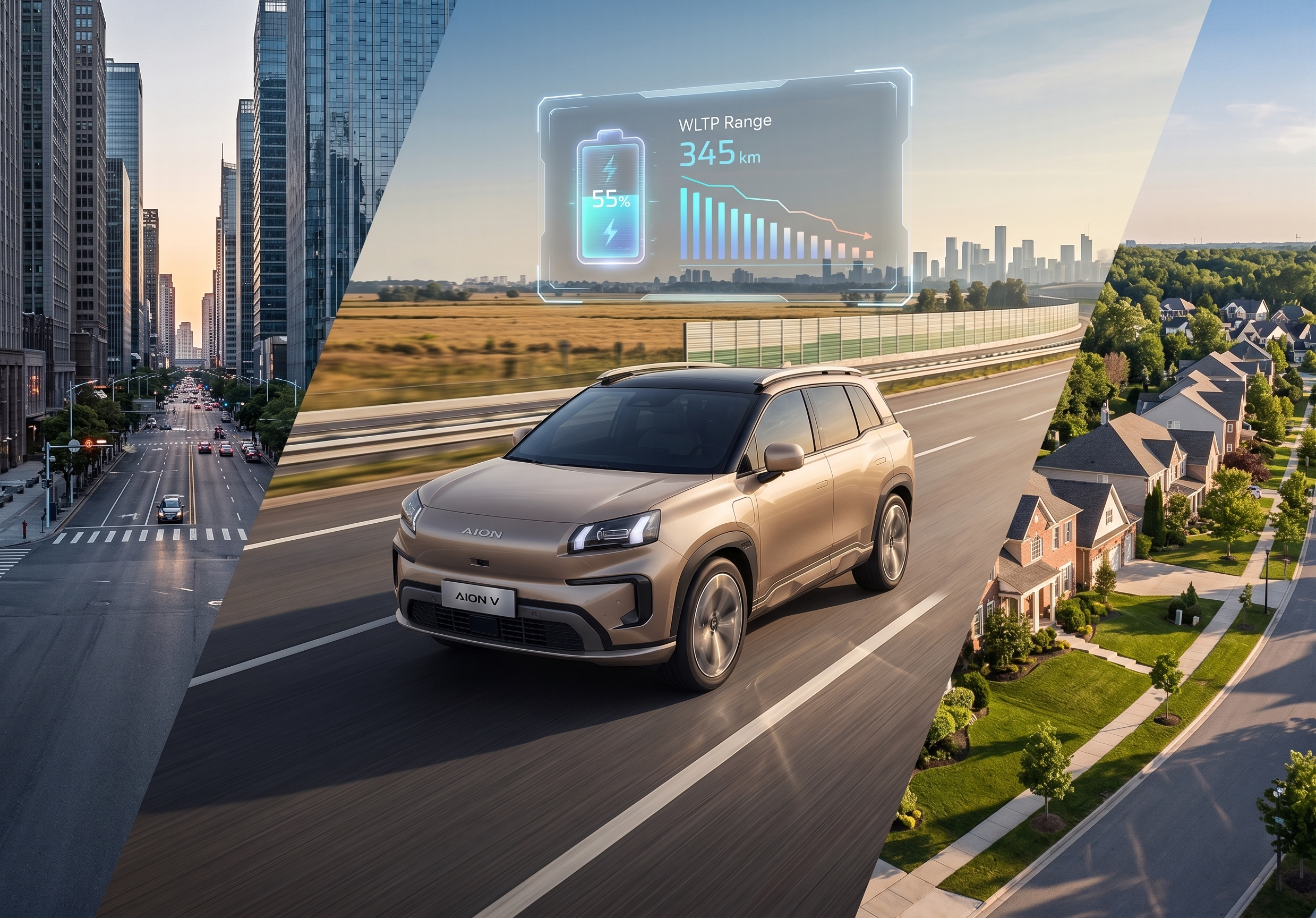
What Does WLTP Mean?
WLTP stands for Worldwide Harmonised Light Vehicle Test Procedure. It is the official, standardised method used to measure the fuel consumption, CO₂ emissions, and electric driving range of new vehicles.
In Europe, WLTP figures are the legally required published range reference for all new cars — including EVs. Every manufacturer must test their vehicles using this method before selling them in the European market. Since September 2018, all new passenger cars registered in the EU must comply with WLTP standards.[1]
This matters because it creates a level playing field. When comparing two EVs, you know both figures were produced under the same conditions. That makes the WLTP range a reliable starting point — even if it doesn't tell the whole story.
How WLTP Testing Works
Understanding what the WLTP range is also means understanding how the test is actually run.
The vehicle sits on a dynamometer — a machine that lets the wheels spin while the car stays stationary. The lab environment is controlled, with a set temperature of 23°C, which is considered optimal for electric vehicle battery performance.[2]
The test follows a set driving cycle called the WLTC. This cycle is divided into four distinct phases, each simulating a different driving speed:
- Low phase— urban, stop-start driving at up to 56.5 km/h
- Medium phase— suburban roads at moderate speeds
- High phase— faster road driving
- Extra-High phase— motorway-style speeds
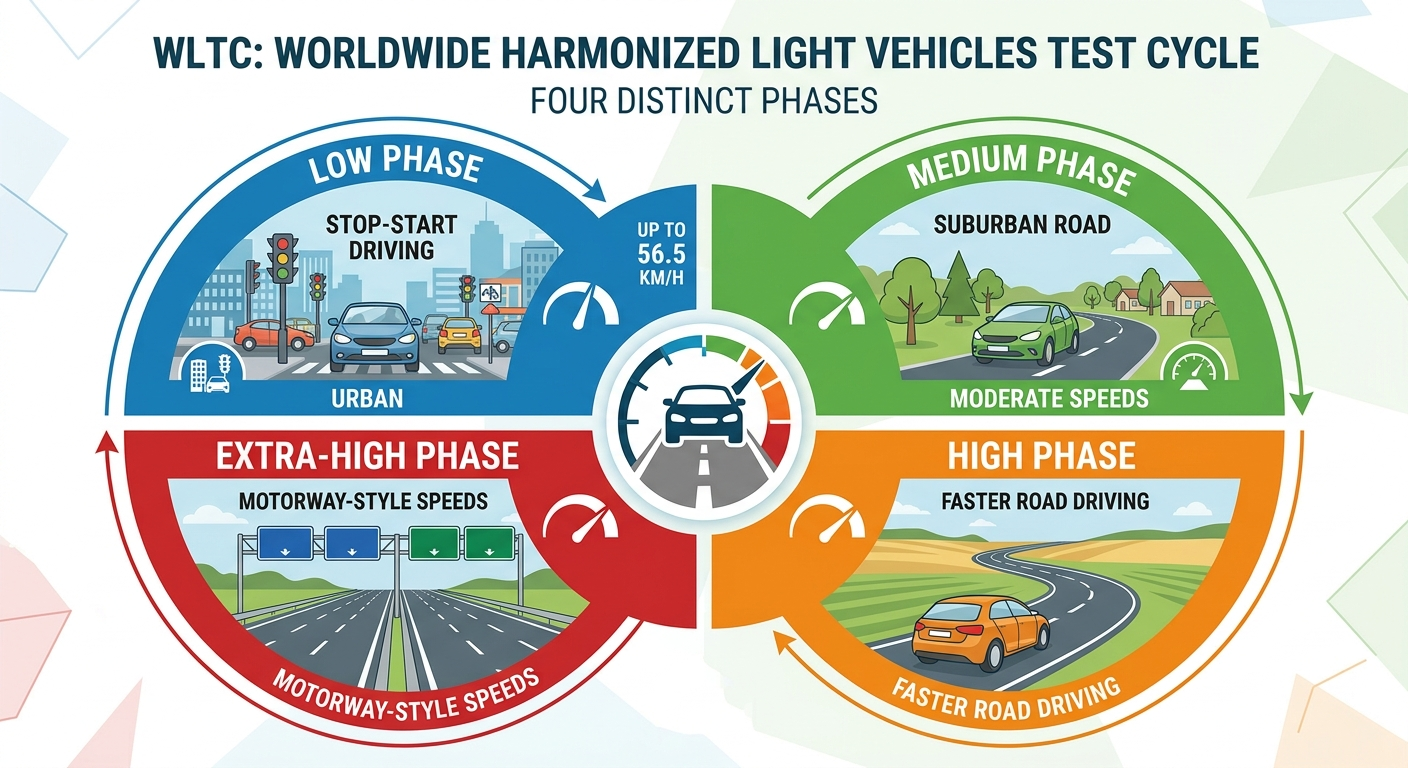
The entire test runs for 30 minutes and covers approximately 23 km. Each phase is weighted and averaged to produce a single combined range figure. Because the cycle is identical for every vehicle tested, the results are repeatable, consistent, and comparable across different models and brands.
The WLTP also accounts for a vehicle’s equipment levels. Options like larger wheels or panoramic roofs can affect energy consumption, so manufacturers must test configurations that reflect real-world spec choices.
Why WLTP Range Differs from Real Life
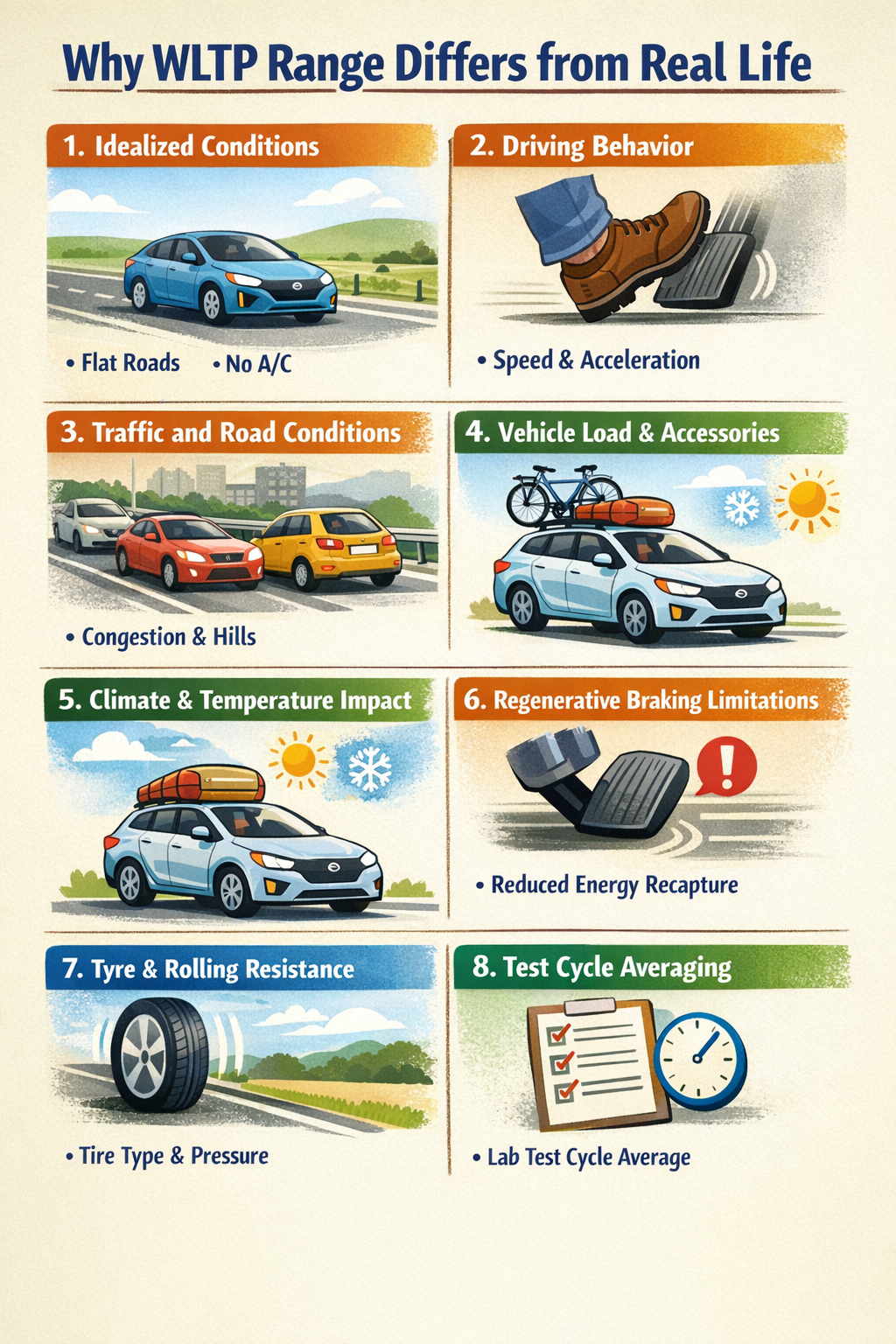
So you now understand what the WLTP range is. But why does the figure sometimes feel out of reach on real roads? Here are the main reasons.
1. Idealized Conditions
The test takes place in a lab at a fixed 23°C. Real European roads are not labs. Temperatures swing dramatically between seasons — and your battery performance swings with them.
2. Driving Behavior
The WLTP cycle follows a scripted speed profile. Spirited acceleration, late braking, or simply driving with urgency will drain energy faster than the test assumes.
3. Traffic and Road Conditions
Stop-and-go motorway traffic, roundabouts, and urban congestion all change energy demands in ways that a fixed test cycle cannot fully capture.
4. Vehicle Load and Accessories
The test runs without passengers or cargo. Add a family of four, luggage, and a roof box, and the energy needed to move the car rises noticeably.
5. Climate and Temperature Impact
Cold weather is one of the biggest range reducers for EVs. At 0°C to -10°C, studies have found real-world EV range can drop by 10–23% compared to the WLTP figure. Air conditioning and heating are also not used during the WLTP test — but you will certainly use them.
6. Regenerative Braking Limitations
WLTP testing includes regenerative braking, but the benefit in real life depends heavily on your driving style and route profile. On a long motorway run with minimal braking, regen contributes very little.
7. Tyre and Rolling Resistance Differences
The test uses specific tyre configurations. Winter tyres, worn rubber, or different tyre pressures all increase rolling resistance and reduce range.
8. Test Cycle Averaging
The four phases are blended into a single combined figure. If your daily drive skews heavily toward motorway speeds — where energy demand is highest — your real-world figure will sit noticeably below the WLTP combined range.
The good news: research suggests WLTP is around 10% optimistic on average, a far more honest result than the old NEDC standard, which could overestimate by 25–30%.
How to Maximise Your Real-World EV Range
Knowing the gap between WLTP and real-world performance empowers you to close it. Here are the most effective strategies, summarised clearly:
| Category | Key Actions | Impact |
| Driving Habits |
Accelerate smoothly, anticipate stops, maintain steady speeds |
High (recover 10–15% of range) |
| Climate Control |
Pre-condition cabin while plugged in; use seat heating over cabin heating |
High (especially in winter) |
| Speed & Drag |
Keep motorway speeds below 110 km/h; remove roof racks when not in use |
High (aerodynamic drag rises sharply at speed) |
|
Tyre Management |
Keep tyres at recommended pressure; use low-rolling-resistance tyres in summer |
Medium |
| Route Planning |
Use the in-car navigation for energy-optimised routing; plan charges in advance |
Medium |
| Regen Braking |
Use the highest regen setting available; coast early before stops |
Medium |
Small changes across each category add up. Drivers who are conscious of their habits typically report real-world EV range much closer to the WLTP figure than those who drive without adjustment.
The AION V: Built for Your Daily Life
If you are looking for long range, the AION V offers a WLTP range of up to 510 km — making it one of the most capable long-range electric SUVs in its class.
But what does that figure actually mean for your life?
- Daily commuting— the average European commuter travels around 30–50 km per day. A full charge in the AION V comfortably covers a week of commuting without needing a top-up.
- School runs and errands— short, repeated trips are where range anxiety often creeps in. With the AION V's aion v range, even a heavy day of school runs, supermarket trips, and after-school activities barely makes a dent in the battery.
- Weekend trips— driving from Paris to Brussels is roughly 300 km. From Munich to Vienna is around 430 km. The AION V handles both journeys comfortably on a single charge in favourable conditions, with a meaningful range in reserve.
- Mixed urban-suburban driving— this is where the AION V truly shines. Stop-start city driving activates regenerative braking, helping recover energy continuously. The transition to suburban roads then allows efficient cruising. The result is a WLTP range that translates well into everyday mixed use.
The AION V also features an industry-leading integrated heat pump, which significantly reduces the energy cost of heating the cabin in cold European winters — one of the biggest real-world range drains addressed directly at the engineering level.
FAQ
1. What is the difference between WLTP and NEDC?
The NEDC was an old test standard created in the 1980s. It was very short, very slow, and highly theoretical. The new standard is much longer and faster. It includes more realistic accelerations and higher top speeds. Therefore, the new figures are much closer to actual reality.
2. Is WLTP useful if it is not the exact real-world number?
Absolutely. The WLTP range is not meant to be a guarantee of what you will see on every drive. Its purpose is to give you a consistent, comparable benchmark. Because every manufacturer uses the same procedure, you can reliably compare the AION V’s range against any other EV on the market — and trust that the comparison is fair.
Think of it as a standardised reference point, not a promise. Pair it with an understanding of how your own driving habits and climate affect range, and you have a genuinely useful tool for making an informed purchase decision.
3. Why do two EVs with similar battery sizes have different WLTP ranges?
Battery capacity is only part of the equation. The WLTP range is calculated by dividing usable battery energy by the vehicle's energy consumption rate.[3] That consumption rate is shaped by many factors: aerodynamic efficiency (the drag coefficient), vehicle weight, powertrain efficiency, tyre rolling resistance, and thermal management quality.
An EV with a sleeker body, a more efficient motor, and a better-engineered heat pump can achieve significantly more range from the same battery than a heavier, less aerodynamic competitor.
Start Your Electric Journey
In summary, standard laboratory testing gives you a reliable tool to compare electric vehicles. It shows you the true potential of the battery under highly controlled conditions. We at GAC Europe design our cars to turn those impressive paper figures into reliable daily performance. The best way to experience this efficiency is to get behind the wheel yourself.
Ready to see what the AION V can do for your commute, your weekend, and everything in between?
Register for a Test Drive Today →
References
[1] Octopus EV. What is WLTP and how does it work? https://octopusev.com/ev-hub/what-is-WLTP-how-does-it-work
[2] Gridserve. What is WLTP range and is it different to real-world EV range? https://www.gridserve.com/what-is-WLTP-and-how-does-it-impact-the-real-world-range-of-my-electric-car/
[3] EVDB.nz. WLTP Explained — Range Calculation. https://evdb.nz/WLTP